Showing posts with label Matt de la Pena. Show all posts

Monday, April 18, 2016

Turn that Picture Book Page! ~ by Patricia Toht

Webster's Dictionary defines a page-turner as "a book, story, etc., that is difficult to stop reading because it is so interesting." 

So, what makes for a great page turn in a picture book? What compels readers to flip to the next spread? 

Above all, a strong story will do the trick, a story that contains elements that propel action forward. Some involve:


• A trip, like this year's Newbery winner, LAST STOP ON MARKET STREET by Matt de la Peña and Christian Robinson. Readers want to know where the journey will ultimately end up.


• A quest, like SAM AND DAVE DIG A HOLE by Mac Barnett and Jon Klassen. Readers turn the page to discover if these diggers will find something spectacular, after all.


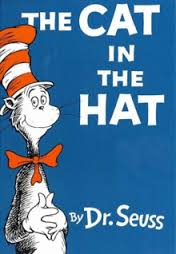
• Strong cause-and-effect. I can still remember that, as a small child reading THE CAT IN THE HAT by Dr Seuss, I actually held my breath when turning one particular page. On that page, the cat was balanced on a ball, holding aloft a huge, teetering tower of things. Could he possibly stay upright? I cringed and turned the page... Nope!


• An escalating problem. THERE WAS AN OLD DRAGON WHO SWALLOWED A KNIGHT by Penny Parker Klostermann and Ben Mantle is a prime example of escalation. The dragon keeps swallowing things, and his growing stomach discomfort surely cannot end well.


In addition to a strong story, or in quieter books or concept books, some other techniques can encourage page turns:

• The use of questions. The nonfiction book, WHAT DO YOU DO WITH A TAIL LIKE THIS? (by Steve Jenkins and Robin Page) uses this technique. To find the answers to this question -

   - readers must turn the page.


• Rhyme. With rhyme, a missing end rhyme will encourage the reader to guess the last word of the stanza, and then turn the page to confirm their guess. Take a look at Miranda Paul's new book, WHOSE HANDS ARE THESE?, illustrated by Luciana Powell. 
(*A warning here -- only write in rhyme if your story demands it and you work diligently to make all the elements of rhyme work. Here is a post on that topic.)


• Sparse text. The best example I can think of for this technique is YO! YES? by Chris Raschka. The entire book contains fewer words than most of my sentences! With few words, readers move forward quickly to add to the story. This book also uses the next technique -


• Alternating characters. With two characters that are fairly balanced in importance and appearance in the story, readers will keep turning the pages to see what is going on with the other character. HERMAN AND ROSIE by Gus Gordon is a personal favorite of mine.


• The use of a "page-turning word" and/or an ellipsis. Alice Schertle uses both in ALL YOU NEED FOR A SNOWMAN, illustrated by Barbara Lavallee. On the spread below, the word "then" followed by an ellipsis requires a page turn to complete the sentence and move things forward.


Picture book editors read tons of picture books and submissions of yet-to-be picture books, so many that they develop a feel, an internal rhythm, of where a page turn occurs. As they read your text, they will subconsciously break your picture book into spreads, adding page turns in their mind. 

You can develop that same feel, that internal rhythm. You can also encourage page turns. How?

#1 READ LOTS OF PICTURE BOOKS

#2 MAKE A DUMMY OF 
YOUR PICTURE BOOK TEXT

#3 INCORPORATE ELEMENTS 
TO ENCOURAGE PAGE TURNS

Never made a dummy before? Don't worry - there's a post for that, too! Check it out here.


So what is your favorite page-turner picture book, GROG readers? Does it include any of the elements above? Something else?

Monday, January 18, 2016

Diversity Via the Lens of Immigrants & Poverty-Part 1 by Kathy Halsey

"Let us turn our thoughts today to Martin Luther King and recognize that there are ties between us, all men and women living on the Earth. Ties of hope and love, sister and brotherhood, that we are bound together in our desire to see the world become a place in which our children can grow free and strong." 
James Taylor, Shed a Little Light

Last week Youth Media Awards honored writers, illustrators, and themes that shed a greater light on diversity. Matt de la Pena's Newbery winner, LAST STOP ON MARKET STREET, isn't just about those who must use public transportation or children whose parents are not present, but it addresses those issues. When I shared this winner with some suburban fifth grader writers, many told me they had never ridden a public bus. They wondered, too, why CJ spoke in a different vernacular then they did. They deemed the book full of "heart," "emotion," and noted how CJ and Nana served others at the soup kitchen. So much said and not said, but implied in LAST STOP that will generate great conversation and understanding.

This great interview w/ David Levithan at BookCon 2015 sheds more light on Matt's thinking as he wrote this gentle story.


In celebration of Dr. King's birthday, I'd like to spotlight another book that open windows and doors for intermediate/middle grade  audiences. Stay tuned for Part 2, Friday, January 22, for a review of a picture book on immigrants.
Cynthia Lord's heartfelt A HANDFUL OF STARS, focuses on the friendship of Lily, raised by French Canadian grandparents, and Salma, daughter of migrant workers. Lord has deftly set up a friendship between these two that highlights their differences and similarities while covering typical tween coming-of-age issues.

Lily makes it clear on page one that, "the only reason I ever spoke to Salma Santiago was because my dog ate her lunch." Neither group, the townies or the migrant families talk to each other. Lily continues, "I don't usually talk to those kids, and they don't usually talk to me. They don't stay here long enough for us to be friends." 

Yet friends they become because they help each other become stronger and better. Examples abound:
  • Lily conquers her fear of being noticed as she helps Salma compete in the annual blueberry queen contest. 
  • Lily empathizes with Salma since her French-Canadian mother broke barriers as queen three years running; she rails against pageant officials who unwittingly act in a condescending manner to Salma.
  • Salma uses her artistic talent to paint mason bee houses with Lily at her grandparents' general store to raise money for Lucky, the blind dog who evokes memories of Lily's dead mother.
  • Salma's mother draws Lily into a tender mother-daughter moment, too. "I looked up to see Mrs. Santiago holding her other arm open to me. My feet ran without me even telling them to."
Readers learn of the French-Candian culture and the migrant culture, both mostly overlooked in children's literature. Both families are of meager means, yet they share blueberry enchiladas and a growing awareness of each others talents and gifts. Salma paints yellow stars on her purpleberries to adorn the bee houses. (Lord explains that berries can be purple, red, black or even striped, but consumers only want the blue ones.)  

Salma says, Stars are one of my favorite things. I love how when you look up at the night, it doesn't matter if you're in Florida or Maine or Michigan or anywhere, it's the same stars. So when I miss someone, I look at the stars and imagine that person seeing same ones as me. No matter where I go, I can think of them, and they can think of me. They're my star friends."  Salma's sadness in never having permanent home is eloquently stated throughout the book in terms that children can understand. (Missing friends, missing pets.)

A HANDFUL OF STARS may have been a dark horse in the Newbery contest, but I give it many stars in the sky for illuminating diverse groups we don't usually see in our canon.

Continue the conversation. Share in the comments some of your Newbery dark horses and diverse favorites. 


Monday, December 14, 2015

Attend a Library Convention! Here's Why. by Kathy Halsey

Columbus Skyline @ AASL
AASL and ALA are not alphabet soup that our favorite literary dog Martha cooked up. They're acronyms for the American Association of School Librarians and American Library Association. In the world of publishing, they have been called gatekeepers, but I prefer the word "ally." As a former school librarian myself, I know our goals are similar- to promote literacy and to engage readers for a lifetime. Librarian go to conferences for the same reason as writers: connections, professional development, and fun.


Even if you are a pre-published writer, you can learn so much from your local school library association conference or one of the national conferences. AASL came to Columbus, OH, my home town, this past fall and I attended the conference for only $25! The secret? Only purchase an exhibit/vendor hall pass. You will miss the great presentations, but chatting up vendors, getting piles of free books, and meeting amazing authors kept me busy.
Only some of the loot I snagged for FREE!
Make a game plan before you peruse the exhibit hall. It is a dizzying array of swag, companies, and librarians. I targeted the vendors by my writing interests: PB, NF,  and library/educational publishers. Look at their displayed books, snag a catalog, introduce yourself as a writer, and hand them your business card. (Tip: The best time to chat with folks you really want to meet is during  concurrent sessions. The vendor hall is almost empty and reps appreciate your interest.)
Discuss commonalities and areas of expertise with the reps. I pitched this blog and its readership to get a free trial to some library apps that could be useful to writers, such as StoryboardThat, an AASL best app. 
Science & Children Journal
Avail yourself of free professional magazines, also. I found PW, School Library Journal, a chapter book series pub, and best of all for NF writers, and Science & Children, a National Science Teachers Association journal. This particular issue's focus is writing in science. Many articles give the appropriate Next Gen Science Standards for articles. Writers can save time if they plug these into their science manuscripts. Visit NSTA for more resources. 
J. Patrick Lewis, Former Children's Poet Laureate
Author Tim Federle, writer of MG, PB, and funny drink books (He knows librarians & their habits well. LOL)


Connecting with the authors seen above along w/the likes of Matt de la Pena, Don Tate, Michael J. Rosen, and Melissa Stewart made AASL a stellar experience! 
Share your conference tips and favorite finds in the comment section so we can all benefit!