Wednesday, January 27, 2016

DECONSTRUCTING MARVELOUS CORNELIUS--By Sherri Jones Rivers

     I took a road trip recently to the wonderful Richland County Library in Columbia, SC. As usual, when I walked in the door a librarian came to me to see how she could help. I handed her a list of about 30 recommended picture book titles I hoped to read. Soon she came over with a stack a mile high, and I dug in. One that stood out to me was Marvelous Cornelius by Phil Bildner, illustrated by John Parra.


     I decided to take it apart to find out what drew me to it. It won several awards, including a Gold in the Parents' Choice Award for Picture Books, and a Junior Library Guild starred review. With some question as to its being classified as fiction or nonfiction, the author's note at the end helps clear that up. It is a fictionalized account of a real resident who lived through Hurricane Katrina in New Orleans.

     The book begins with a quote by Martin Luther King, Jr., which sets the tone of the book--that no job is inconsequential. Here are some writing tools he used within the story:

                                  ALLITERATION

     The language used is folksy and full of alliteration, as in

   ...couple with the baby on the balcony
   ...truck rounded the turn
   ...kids crowding the corner
   ...whistled and whirled, hooted and hollered


                                     ONOMATOPOEIA

                "Woo! Woo! Wooooo!" "Woo! Woo! Woooo!"
                   (His call when it was time to stop the truck)

                            "Rat-a-tat-tat!"  "Rat-a-tat-tat!"
              (He strums the side of the truck when time to go)

                           "Hootie Hoo!"  "Hootie Hooo!"
                                   (His very favorite call)


                     HIS WORDS DANCE ON THE PAGE

               Cornelius front flipped to the curb
                                  and flung the bags over his head
                                           behind his back
                                                between his legs
                                                     into the truck.


                                                     EXAGGERATION

     ... They (the bags) landed in a perfect pyramid inside the hopper's metal mouth.
     ... He clapped the covers like cymbals and twirled the tins like tops.


                                SIGNALING A CHANGE

                              But then one day, the storm came.                 
                                The great city filled with water.


                     ENDING TIES BACK TO BEGINNING

      On page 4, Cornelius speaks to "the silver-haired man with the paper, the couple with the baby on the balcony, and the woman shaking rugs out at her front window."
     At the end, we see those same people as they pitch in to help after Katrina.


     Sadly, Cornelius passed on as the city was being rebuilt, but his spirit remains a forever part of New Orleans.

     The art by John Parra is a perfect match for the text in this tale of a folk hero with energy, spirit, magnetism and maybe a little bit of magic thrown in for good measure. I hope to post an interview with the artist in the future. Stay tuned!

Monday, January 25, 2016

Multicultural Children's Book Day 2016: Reviewing Gayle Swift's Adoption ABC's -- by Christy Mihaly

It's that time again! Multicultural Children's Book Day is coming on Wednesday, January 27th, and GROG is happy to be participating for the second year. 

Readers, parents, teachers, caregivers and librarians can read book reviews, find author visits, and attend fun events to celebrate MCCBD. Follow along on Twitter and other social media at: #ReadYourWorld. 

MCCBD's mission is: 
to raise awareness for the kid’s books that celebrate diversity, 
AND 
to get more of these books into classrooms and libraries.

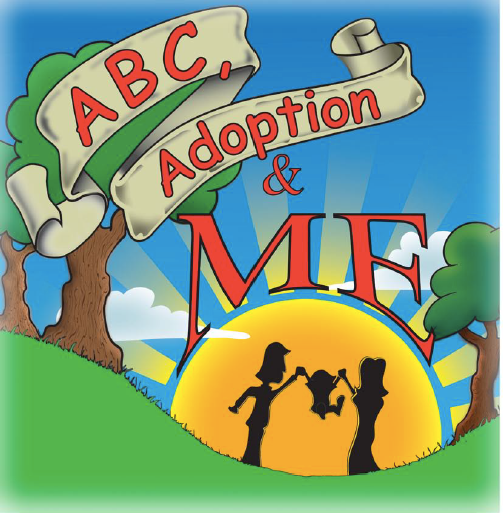
Today for MCCBD, I'm sharing an ABC book about adoption, including culturally diverse adoption. ABC, Adoption & ME is an award-winning picture book written by Gayle Swift. She is an Author Sponsor of MCCBD, and founder of GIFT Family Services, which supports families around adoption. Gayle Swift also has personal experience with adoption and fostering. Her daughter, Casey Swift, an adoptee, collaborated in the writing of the book. Paul Griffin illustrated. 


ABC, Adoption & Me presents a range of topics of interest and concern to adoptive families, in an ABC format. Narrated by an adopted child, it's intended to stimulate meaningful conversations among families about adoption issues from A to Z. 

Here are three of my favorites: 


The illustrations show that many adoptions are multiracial and/or multicultural, and that all families are different. 

The authors include helpful additional information to guide adults in using the book. For example, while reading the pages with your child, explore his or her reactions. How is your family different from the pictured family? How is it similar? How do your feelings compare with those of the child in the book? 

As the book's note to parents explains, adopted children may have questions and fears, and their feelings about adoption may sometimes be "stormy." The authors urge adoptive parents to help their children "braid [their] dual heritage into healthy unity." Kudos to Gayle Swift for creating this helpful resource for adoptive families and foster families who are doing the important work of building happy, healthy families. 

ABC, Adoption & Me is available at Barnes & Noble and elsewhere online. See more about Gayle and her book on her website and Facebook.


#ReadYourWorld
Multicultural Children’s Book Day 2016 
Medallion Level Sponsors are: 


Multicultural Children’s Book Day's amazing Co-Hosts: 

All Done Monkey * Crafty Moms Share * Educators Spin on it * Growing Book by Book * Imagination Soup *  I’m Not the Nanny *  InCultural Parent * Kid World Citizen  
 Mama Smiles * Multicultural Kid Blogs * Spanish Playground

And Don't Forget the MCCBD Classroom Reading Challenge:  
The Classroom Reading Challenge offers teachers and classrooms the chance to (very easily) earn a free hardcover multicultural children's book for their classroom library. 
These books are not only donated by the Junior Library Guild, but they are pre-screened and approved by them as well.

Happy MCCBD! 
And Happy Reading, today and every day.

Thursday, January 21, 2016

Diversity Via the Lens of Immigrants and Poverty- Part 2 by Kathy Halsey

On Monday, I discussed Cynthia Lord's great middle grade book, A HANDFUL OF STARS and today I share thoughts on THE MATCHBOX DIARY, a picture book, by Paul Fleischman. But first, some food for thought from our new National Ambassador for Young People's Literature, Gene Luan Yang. Gene's platform for his two year term is "Reading Without Walls." 

"Reading breaks down the walls that divide us. By reading, we get to know people outside of our own communities. We gain knowledge others don't expect us to have. We discover new and surprising passions. Reading is critical to our growth, both as individuals and as a society." 
Gene Luan Yang


  • The immigrant experience is known to most of us via our grandparents or family history, yet it is a flashpoint in politics today. Newbery Medalist Paul Fleischman's poignant tale uses objects and the love of a great-grandfather and granddaughter to cement the truth of immigration in our minds and hearts. Sepia tone illustrations by Bagram Ibatoulline give a historic, photographic quality to the story that takes the reader back in time to a little boy who can neither read nor write, but he can collect and save his personal history from Italy and in America.


Children love collections and boxes, and Fleischman knowingly designs an engaging history lesson from great-grandfather's matchbox collection. The reader learns from the granddaughter's questions and perspective of a life much different than her own just two generations later. 

Great grandfather's life is simply told, but it holds great details of the trials and triumphs of poverty, hard work, and loving family ties still strong today. The first box holds an olive pit that the young boy sucked on when there was little food. Another reveals a fancy hairpin left by a rich woman on the voyage from Naples to America. Still anthers recalls great grandfather's fear of men in New York he nicknamed "buttonhook men." The fear? At Ellis Island, men would use buttonhook handles to roll up children's eyes to inspect for disease. 

The entire family works at canning fish, sorting peaches, peeling shrimp, and more as they traveled to create a life in America. These new arrivals were shunned. As great grandfather tells it while sharing a box with a lone tooth,  "The same people who bought our cans of sardines wouldn't look at us. Back then some people didn't want Italians here. Sometimes boys threw rocks. That's how my tooth got here."   
Successes followed: learning to read around age 10, work as a typesetter, and Finally opening a bookshop. Through it all, collections grew. 

In the final full spread, the granddaughter and great grandfather converse: 
"I wish I could write a diary." 
"Do you go to school yet?"
"To kindergarten."
"Lucky girl. You'll be writing before you know it. 'Till then, I'll bet you're a good collector, like me."
Our final illustration shows the pre-schooler back on a plane, a matchbox in her lap beginning her collection. It is priceless, so go get this book and enjoy the journey of this book yourself and read it to a special someone. Read without walls.
(A few links:  for teachers , and a video.)

Wednesday, January 20, 2016

A Celebration of Picture Books ~By Suzy Leopold


The kid lit world always seems to be buzzing with news. The good news includes announcements of book birthday celebrations that debut new books, awards for distinguished and deserving books, along with many amazing events happening at bookstores, and much more.

Last week many outstanding books were recognized by American Library Association, ALA. The Caldecott Medal is defined by the ALA as:

The Caldecott Medal was named in honor of nineteenth-century English illustrator Randolph Caldecott. It is awarded annually by the Association for Library Service to Children, a division of the American Library Association, to the artist of the most 
distinguished American picture book for children. 


As everyone knows the committee presented the 2016 Caldecott Medal to: 

FINDING WINNIE: THE TRUE STORY OF THE MOST FAMOUS BEAR by Lindsay Mattic with illustrations by Sophie Blackall.


FINDING WINNIE:
THE TRUE STORY OF THE WORLD'S MOST FAMOUS BEAR
This is a remarkable story named after the Canadian city of Winnipeg that inspired the story of Winnie-the-Pooh. You can read more about the illustrator Sophie Blackall in TIME for Kids.

And now on to the 2016 Caldecott Honor Books . . . 
TROMBONE SHORTY


TROMBONE SHORTY is a stunning autobiography about Troy Andrews. He is a legendary artist from the New Orleans Jazz Fest. Growing up in the New Orleans' district of Tremé, Troy lead his own band at the age of six. The illustrations by Bryan Collier are a combination of paintings and collage and received the 2016 Coretta Scott King Book Illustrator Award.
WAITING
An pig, a bear, a puppy, a rabbit and an owl are waiting. What are they waiting for as they look out the window sill? Kevin Henkes is a master picture book creator and has written many beloved books. WAITING was also recognized for the Theodore Seuss Geisel Award. For more information about Kevin Henkes click on his name to read his bio.
VOICE OF FREEDOM
FANNE LOU HAMER

VOICE OF FREEDOM celebrates the life and legacy of Fannie Lou Hammer [1917-1977]. Fannie Lou was an American voting rights activist, civil rights leader and philanthropist. Find out more about Fannie Lou in an article on the History web site. Her tombstone in Mississippi indicates, "I am sick and tired of being sick and tired." In addition to receiving the Caldecott Honor Award, this book with a message of hope received a 2016 Robert F. Sibert Honor Book. A 2016 Steptoe New Talent Illustrator Award Winner was given for the illustrations of mixed media and collage by Ekua Holmes. 

LAST STOP ON MARKET STREET
LAST STOP ON MARKET STREET, by Matt de la Peña and illustrated by Christian Robinson received many awards and include: 2016 Coretta Scott King Illustrator Honor Book, a New York Times book Review Notable Children’s Book of 2015, A Wall Street Journal Best Children’s Book of 2015 and the prestigious John Newbery Medal.

The reader will appreciate the beautiful moments between CJ and his Grandma as they spend their time together on a Sunday afternoon. The illustrations are a mix of acrylics and collage. Carter Higgins shares an excellent post about the Design of the Picture Book along with her excitement that we share for the awards presented to LAST STOP ON MARKET STREET.

In case you missed it, two fellow GROGgers recently shared information on the title of LAST STOP ON MARKET STREET and the award. You can find a GROG post by Kathy Halsey this past Monday. Last week, Tina Cho wrote a post about the prestigious Caldecott Award. The information shared by Kathy and Tina are both great posts, so make sure you check them out if you haven't already done so.

Along with the good news of these prestigious awards, comes those who grumble and scratch their heads. There are those who question the judges' decisions to recognize and honor these picture books. For myself, I am pleased and excited to celebrate each one of these titles.

Those who write for children know the challenges that come with being a writer. The journey to publication is most often a long journey. There is no need to question the decision of the judges. This is time to celebrate books! It is a time to recognize all the hard work the creators-authors, illustrators, editors, and many more, strive for in the world of publishing. All are deemed award winners. 

Monday, January 18, 2016

Diversity Via the Lens of Immigrants & Poverty-Part 1 by Kathy Halsey

"Let us turn our thoughts today to Martin Luther King and recognize that there are ties between us, all men and women living on the Earth. Ties of hope and love, sister and brotherhood, that we are bound together in our desire to see the world become a place in which our children can grow free and strong." 
James Taylor, Shed a Little Light

Last week Youth Media Awards honored writers, illustrators, and themes that shed a greater light on diversity. Matt de la Pena's Newbery winner, LAST STOP ON MARKET STREET, isn't just about those who must use public transportation or children whose parents are not present, but it addresses those issues. When I shared this winner with some suburban fifth grader writers, many told me they had never ridden a public bus. They wondered, too, why CJ spoke in a different vernacular then they did. They deemed the book full of "heart," "emotion," and noted how CJ and Nana served others at the soup kitchen. So much said and not said, but implied in LAST STOP that will generate great conversation and understanding.

This great interview w/ David Levithan at BookCon 2015 sheds more light on Matt's thinking as he wrote this gentle story.


In celebration of Dr. King's birthday, I'd like to spotlight another book that open windows and doors for intermediate/middle grade  audiences. Stay tuned for Part 2, Friday, January 22, for a review of a picture book on immigrants.
Cynthia Lord's heartfelt A HANDFUL OF STARS, focuses on the friendship of Lily, raised by French Canadian grandparents, and Salma, daughter of migrant workers. Lord has deftly set up a friendship between these two that highlights their differences and similarities while covering typical tween coming-of-age issues.

Lily makes it clear on page one that, "the only reason I ever spoke to Salma Santiago was because my dog ate her lunch." Neither group, the townies or the migrant families talk to each other. Lily continues, "I don't usually talk to those kids, and they don't usually talk to me. They don't stay here long enough for us to be friends." 

Yet friends they become because they help each other become stronger and better. Examples abound:
  • Lily conquers her fear of being noticed as she helps Salma compete in the annual blueberry queen contest. 
  • Lily empathizes with Salma since her French-Canadian mother broke barriers as queen three years running; she rails against pageant officials who unwittingly act in a condescending manner to Salma.
  • Salma uses her artistic talent to paint mason bee houses with Lily at her grandparents' general store to raise money for Lucky, the blind dog who evokes memories of Lily's dead mother.
  • Salma's mother draws Lily into a tender mother-daughter moment, too. "I looked up to see Mrs. Santiago holding her other arm open to me. My feet ran without me even telling them to."
Readers learn of the French-Candian culture and the migrant culture, both mostly overlooked in children's literature. Both families are of meager means, yet they share blueberry enchiladas and a growing awareness of each others talents and gifts. Salma paints yellow stars on her purpleberries to adorn the bee houses. (Lord explains that berries can be purple, red, black or even striped, but consumers only want the blue ones.)  

Salma says, Stars are one of my favorite things. I love how when you look up at the night, it doesn't matter if you're in Florida or Maine or Michigan or anywhere, it's the same stars. So when I miss someone, I look at the stars and imagine that person seeing same ones as me. No matter where I go, I can think of them, and they can think of me. They're my star friends."  Salma's sadness in never having permanent home is eloquently stated throughout the book in terms that children can understand. (Missing friends, missing pets.)

A HANDFUL OF STARS may have been a dark horse in the Newbery contest, but I give it many stars in the sky for illuminating diverse groups we don't usually see in our canon.

Continue the conversation. Share in the comments some of your Newbery dark horses and diverse favorites. 


Wednesday, January 13, 2016

Appreciations, Kate! Hello Gene! by J.G. Annino


In many U.S. states & other places where this
blog reaches, it is cold and wet.
Any gray blahs of winter can be banished by
a warm welcome for the new National Young
People’s Literature Ambassador affiliated
with the Library of Congress.

On January 7, 2016 the successor to Ambassador
Kate DiCamillo visited room L-119 in the
Thomas Jefferson Building of the Library of
Congress to accept the honor.   
                                                      
Widely popular author/comics illustrator Gene Luen Yang met widely popular author
Kate DiCamillo, who praised him in this statement from the Library of Congress -

“Gene Yang is a talented writer. He is a brilliant artist. 
His stories are thought-provoking, genre-bending, utterly original 
examinations of the human heart. In short, Gene Yang is a 
renaissance man. I am so honored to pass the torch of this sacred 
task to Gene. No one is better suited for bringing us all together.” 

So, appreciations outgoing laureate, KATE DICAMILLO.
Here is a lovely visit with her conducted for
The Horn Book in November 2015. We are glad you will
have more time to imagine, create, & write more books. And, did everyone
here at Group Blog have a chance to read her August, 2015 release? Go!

GENE LUEN YANG is familiar with kids+reading+schools, as he
has enlivened many hours in the classroom for students
as a Bay Area computer science, math and art teacher.
He now is an educator, not only as the U.S. Young
People's Literature Ambassador for the next two years, but
also but with Hamline University’s Children’s and 

He says his focus is the intersection of stories and
illustration. Although he is famous for award-winning graphic novels,
he says he is interested in what makes most readers of this blog
pay attention - picture books. 
Although I couldn't find that he has published a picture book, I'm hoping
that the youngest readers will be gifted with his first children's picture
book not too far away.

Gene re-invented the Pat-A-Cake child’s
rhyme for his contribution in NURSERY RHYME COMICS &
he is one of the cut-ups who contributed to COMICS SQUAD.


In addition to our welcome today, Gene has been applauded 
in many articles posted online & here are only two.


One of his many honors is that he earned Young
People's Literature category finalist status, in the National Book Awards
in the same year that his AMERICAN BORN CHINESE graphic
novel (not autobiographical as
many people assume) of three stories,
won the coveted ALA teen book honor,
the Michael L. Printz Award (named for a Topeka, Kansas librarian
and active children's literature specialist, who
in his short life, discovered author Chris Crutcher.)

I hope during his two years, Gene Luen Yang is able to visit a school, bookstore, library
or book conference near you - and me :) Thank you for taking on this important job, Gene!
While waiting for him to visit, you can listen to this podcast.

                                      official photo of Gene Luen Yang, from First Second Books


Monday, January 11, 2016

Fracturing a Fairy Tale ~ by Patricia Toht

Back in July, I wrote a post about creating a picture book text by giving an old theme a new twist. Today I'm going to focus on one popular way of doing this --  


Let's fracture some fairy tales, folks!

Fractured fairy tales are nothing new. From way back in the 1960's comes historic proof:

Obviously there's staying power in fractured fairy tales. So, how exactly do you make a fairy tale dance to a different tune? Here are just three of the moves you can do to change a fairy tale or childhood story/rhyme.

The Two-Step (or Three-Step, Four-Step, Five-Step, ...)

Take a short, simple childhood rhyme or story and add to it, expand it. The crucial factor is to assure that the expansion has a story arc to it that will propel the reader forward. Jim Aylesworth has written picture books in this vein.


THE COMPLETED HICKORY DICKORY DOCK begins with the well-known verse and then the author extends it by following the mouse through twelve hours of the day. The book is written in verse, each stanza opens with a fun-to-say nonsense word. The reader can count up the hours as the mouse moves through the day.


MY SON JOHN ends with the familiar verse. Readers follow an arc from sun-up to sun-down. Each spread depicts another child from the rural area taking part in simple activities. Son John ends the day in bed with his one shoe on.


The Twist


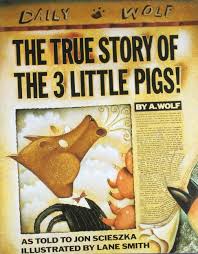
THE TRUE STORY OF THE 3 LITTLE PIGS by Jon Scieszka is a well-known example of a fractured fairy tale. The story is relayed by the wolf, who tells the "true" story of what happened with the pigs from his point of view. According to him, the whole misunderstanding was about a cup of sugar and a case of the sneezes. If you'd like to try writing something similar, take the "bad guy" of a story and examine events from his/her point of view, being sure to add lots of emotion. How does that change the story?


NINJA RED RIDING HOOD by Corey Rosen Schwartz. Corey has written a Ninja trilogy; each one combines a childhood tale with ninja training. The limerick verses in this one are terrifically catchy, and the author manages to work in traditional lines (e.g. "The better to see you with, my dear") with seeming effortlessness. She also dares to even out the match between Wolf and Red -- they've both had ninja lessons! Someone else shows up in a gi to help save the day. To twist like Corey does, select a well-known childhood story and add an element that kids are crazy about. Tara Lazar's "500+ Things that Kids Like" is a great source for brainstorming.


The Mash

What might happen if you mash together a whole bunch of tales or characters? 

Tara Lazar's LITTLE RED GLIDING HOOD is one-part twist and one part mash up. It begins with an amazing title. Obviously "gliding" implies that Red is doing something special -- she's skating. Tara sets a goal for Red that reflects the title. What would a skater want? Why, to win a skating competition, of course. This storyline propels the reader through the story (on a ribbon of ice). But the author adds SO much more! Easily recognized characters are peppered throughout the story, and the feared big bad wolf is not-so-bad after all. Cleverness and puns abound.


The tale in INTERRUPTING CHICKEN by David Ezra Stein combines several childhood stories, but doesn't really scramble them up. As Papa Chicken reads his Chick a bedtime story, Chick keeps interrupting the stories by jumping in them to save characters from harm. 

Penny Parker Klostermann (who won the Best in Rhyme award for THERE WAS AN OLD DRAGON WHO SWALLOWED A KNIGHT) has said that INTERRUPTING CHICKEN was one of the mentor texts for her upcoming mash up, A COOKED UP FAIRY TALE (Summer, 2017). For an interview with Penny about her use of mentor texts, see the interview here.

I hope these examples will give you some ideas for fracturing fairy tales. Start dancing, writers, and see what shakes out!