Wednesday, October 7, 2020

Picture Books for Civic Engagement and Social Activism ~Christy Mihaly


Greetings! 
A quick announcement up front: I'm excited to be serving as a Round 1 panelist for the Cybils book awards this season, in the Nonfiction category. I'll be very busy reading many fabulous books over the next couple of months! Nominations are open through October 15, and anyone can nominate a worthy book--more info here.
~Christy

Today's Topic: Picture Books and Civic Engagement 
In 2020 we face an election year like no other. Amidst the disruptions to schools, schedules, and psyches, many adults are wondering how they can engage young people in meaningful conversations about our nation's challenges. 
Picture books can help. There's a cornucopia of recent releases to choose from. I asked a passel of creators of recently published picture books to share their inspirations, insights, and pointers for using these books in engaging with kids. 
Don't miss the additional titles they recommend, at the end of the post. And finally, I've included links to book-related additional resources.

Books about Civics
Sometimes we want a book that introduces the conceptual framework of democracy: elections, rights, and the roles of government officials. 

When Catherine Stier couldn't find a book to help her explain to her preschoolers what the President is supposed to do, she wrote it herself.  If I Were President (Albert Whitman, 1999, illustrated by DyAnne DiSalvo-Ryan) offers a kids'-eye view of the presidency. 

Stier's recently released A Vote is a Powerful Thing (Albert Whitman, Sept. 2020, illustrated by Courtney Dawson), provides a kid-friendly take on elections. Stier says she encourages adults sharing this book to talk with kids about issues that are important to them, and encourage them to design campaign posters for causes they care about.

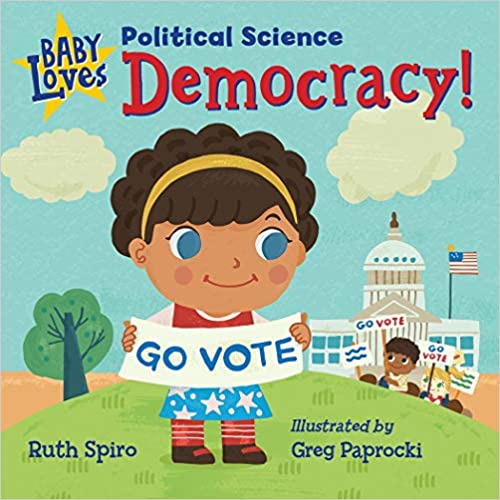
Ruth Spiro's "Baby Loves Political Science" board books explain democracy's basics to even younger kids. (Charlesbridge, 2020-2021, illustrated by Greg Paprocki.) It's never too early to start!
Ruth explains that these new additions to her popular "Baby Loves Science" series use everyday events and observations to teach the fundamentals of government. Democracy introduces elections, while Justice, along with the forthcoming Congress and The Presidency, cover the three branches of government.

In a similar vein, in Free for You and Me: What Our First Amendment Means (Albert Whitman, 2020, illustrated by Manu Montoya) my intention was help kids appreciate the freedoms guaranteed by the First Amendment, and to understand how these freedoms shape our lives. I incorporated poems, historical vignettes, and a contemporary story in which kids exercise their rights to make the world a better place. While some high-profile adults don't always seem to understand the Constitution, I hope this book gives young readers a good start on the road to civic engagement. 

Books to Foster Social Engagement

What better way to capture a young reader's imagination than with a well-told story? That's what these picture books do. Here's a selection of excellent recent and forthcoming PBs that use true stories to bring history to life, promote empathy, and encourage young people to get involved in their communities.

No Voice Too Small: Fourteen Young Americans Making History (Charlesbridge, 2020) profiles 14 contemporary young activists with brief bios and poems by diverse poets. Edited by Lindsay Metcalf, Keila Dawson and Jeanette Bradley, with art by Jeanette Bradley, this book invites kids to read it again and again. It includes back matter explaining the poetic forms, profiles of the poets, and suggestions for activism.

Jeanette Bradley says her daughter inspired her to create this book. After reading other picture book biographies, she told Jeanette, "I wish I lived in the past, so I could change things." This child had concluded, from her reading, that only famous dead people could make a difference in the world! Jeanette hopes that by collecting the stories of modern activist kids, she can correct this misconception and "empower kids to speak out and act when they see a wrong." 

The book's editors also created additional materials to inspire engagement. Keila wrote an activity guide, and Lindsay and Jeanette collected book club materials for teachers on Flip Grid. As Keila says, not only should kids learn about leaders from the past, but they also "can be a part of making history too."
  
Author Elisa Boxer is drawn to unsung heroes. In The Voice That Won the Vote: How One Woman's Words Made History (ill. Vivien Mildenberger, Sleeping Bear Press, 2020), she celebrates a lesser-known figure in the women's suffrage movement. Febb Burn was a mother who helped push through the ratification of the 19th Amendment by writing a letter to her lawmaker son. This story resonated for Elisa, who knew it could "help children realize the power of one voice, and one vote." She hopes her book will "inspire children to give voice to what matters to them." 
Beth Anderson was also moved to tell the story of a lesser-known woman. Lizzie Demands a Seat: Elizabeth Jennings Fights for Streetcar Rights (ill. E.B. Lewis, Calkins Creek, 2020) introduces readers to a young African American schoolteacher in New York City who fought against segregated streetcars in 1854, a century before Rosa Parks took her stand.

In presenting this book to young people, Beth highlights how the "heroic people that come before us inspire us and how we, too, have a responsibility to leave 'footsteps' to inspire others that follow us." Beth leads the kids in an activity in which they trace their feet on colored paper and cut out "footprints." On one footprint, she asks them to write the names of those who have inspired them, and on the other, how they'd like to inspire others.

Author Traci Sorell works to bring greater visibility to members of the Native Nations in literature for young people, and to empower kids to use their voices. Her first Picture Book, We Are Grateful: Otsaliheliga (ill. Frane Lessac, Charlesbridge, 2018), offers readers a look at contemporary Cherokee life. Traci continues to bring Native stories to light in many formats. Look for her forthcoming nonfiction picture books, Classified: The Secret Career of Mary Golda Ross, Cherokee Aerospace Engineer (Millbrook 2021), and We Are Still Here! Native American Truths Everyone Should Know (Charlesbridge 2021).

Do you have other favorite books to share on these topics? Please leave them in the comments! 

More Recommended Recent Picture Books for Young Activists
☑ Sometimes People March, by Tessa Allen (Balzer + Bray, 2020)
☑ Shirley Chisolm is a Verb, by Veronica Chambers, ill. Rachelle Baker (Dial Books, 2020)
☑ Memphis, Martin, and the Mountaintop: The Sanitation Strike of 1968, by Alice Faye Duncan, ill. R. Gregory Christie (Calkins Creek, 2018)
☑ Shaking Things Up: 14 Young Women Who Changed the World, by Susan Hood, ill. Sophie Blackall and 12 more (Harper Collins, 2018) 
☑ We Are Water Protectors, by Carole Lindstrom, ill. Michaela Goade (Roaring Brook, 2020)
☑ Vote for Our Future! by Margaret McNamara, ill. Micah Player (Schwartz & Wade, 2020)
☑ Peaceful Fights for Equal Rightsby Rob Sanders, ill. Jared Andrew Schorr (Simon & Schuster, 2018)
☑ The Teachers March: How Selma's Teachers Changed History, by Sandra Neil Wallace, Rich Wallace, ill. Charly Palmer (Calkins Creek, 2020)

Additional Resources


Thursday, October 1, 2020

WHOOO KNEW? THE TRUTH ABOUT OWLS

From the desk of Suzy Leopold

Do you know some names of owls indigenous to your state? My state of Illinois is home to eight owls.

  • Barn Owl
  • Bared Eagle Owl
  • Eastern Screech Owl
  • Great-Horned Owl
  • Long-eared Owl
  • Northern Hawk Owl
  • Northern Owl
  • Snow Owl
Most of the species that live in my state are mentioned in today’s featured picture book on the GROG Blog.

WHOOO KNEW? THE TRUTH ABOUT OWLS 

written by Annette Whipple made its debut yesterday!

This informational picture book is published by Reycraft Books, 2020. The thirty-two page book is written for ages 6-10.

Now for another question . . . Do you know how many owl species there are in the world? There are 250 Strigiformes that belong to this order of birds.

The information presented in this book uses the Q & A format.

Check out this amazing two page spread:

Note the question, What’s For Dinner? 

The answer follows to tell the reader what this predator hunts for. A photograph is included to show small mammals on a dinner plate! The outstanding photography is sure to amaze the reader and encourage more curiosity about these majestic birds of prey.

Here is another spread:
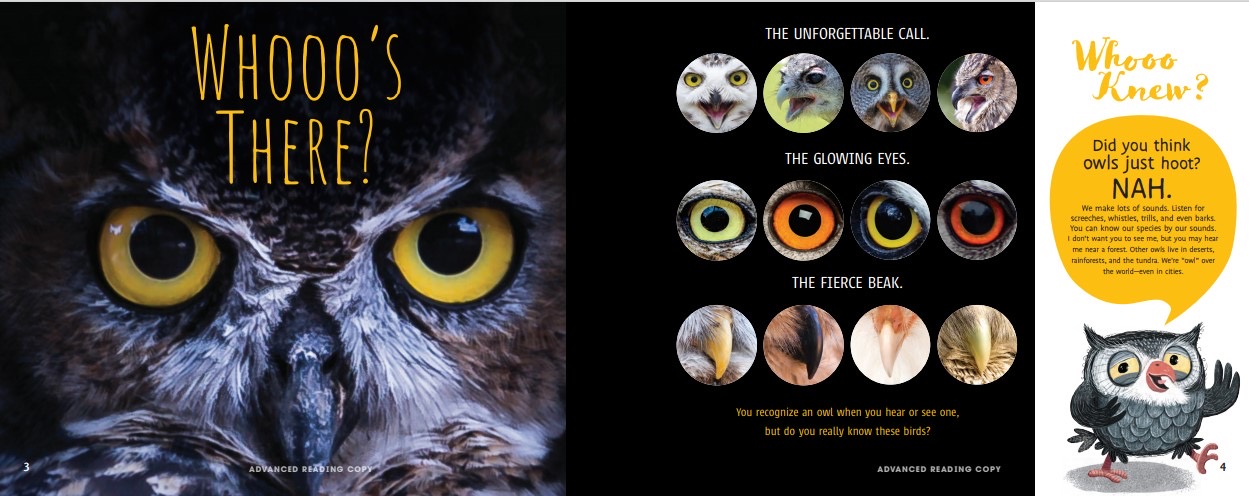
Once again an answer follows the question, Whooo’s There?

This time focus on the sparky, open-eyed owl. Several animated owls are included throughout the book. These illustrated owls share answers to questions, too. This feature is included on each spread along with the superb photography.

If you're not familiar with the anatomy of an owl, page 29 includes information about eyes, ears, ear tufts, feathers, talons, and facial disks. 

One section explains how the reader can help owls and states:

"You can help owls and other wildlife by letting nature be wild."

The back matter includes a list of seven words in a glossary and several links to helpful websites.

Thank you, Annette, for sharing your love of owls and for encouraging readers to explore the world around them through your many nonfiction picture books.

This book is not only a hoot to read, the reader will acquire new facts about this interesting bird. 

Now I know! Next time I hear a screech, a whistle, a trill or a bark, I will see if I can identify the owl.

I give this book a total of five stars out of five.
And now Annette shares a craft of writing tip about first lines and how they matter.

From the desk of Annette Whipple

When I was revising Whooo Knew? The Truth About Owls, I knew I loved most of the text. It’s a picture book in question-and-answer format. Every page spread in the informational book has one Q & A as well as a related sidebar. The sidebars bring humor to the text. 


As I revised, I suspected my original first lines just wouldn’t hook a reader. But I felt a bit stuck.


“Owls are easy to recognize. They have big heads, flat faces, and hooked beaks. They’re known for their hunting skills. But do you really know these birds?” 


While at a Highlights conference, the instructor wanted us to focus on first lines. I knew it was an issue with my manuscript, so I was thrilled to do so.


I scribbled and scratched until our instructor asked us to stop. Then, like in many workshops, he asked if anyone wanted to share what they wrote. Without missing a beat, I raised my hand with a grin.


First, I read aloud the original introduction/nonhook.


Then, I shared my new introduction which became…

“The unforgettable call. The glowing eyes. The fierce beak. You recognize an owl when you hear or see one, but do really know these birds?”


See the spread above Whooo’s There? in the ARC [Advanced Reading Copy].


(They actually cheered! I was shocked at that. Writing friends matter.


Oh, the Highlights faculty member who led that session? He works with Reycraft Books, the publisher of Whooo Knew? The Truth About Owls. And next year Reycraft will continue The Truth About series. The next two books are about dogs and spiders! They are all in Q&A format and highly visual with tons of photographs. Each page spread includes an illustrated sidebar.


Now, anytime I know something isn’t working, I sit down with focus. I set the timer and don’t change tasks (or tabs) until the timer goes off. 


First lines matter. Make your manuscript more enticing—and more sellable—by dedicating time to them. That’s the first lesson of this blog post. The second? Attend conferences and workshops like SCBWI and Highlights—even online. You’ll be challenged to try new techniques.


Thanks so much for having me here today. We know first lines are important, but sometimes it takes some extra effort and time to really hook the reader.


For more information about Annette click on these links:


Check out this previous GROG Blog post from August 2020.

Annette Whipple, Children’s Author, Inspiring Curiosity and Wonder

Sign up for Annette’s Monthly Newsletter

A Writing course: Kid Lit Creatives 

Use this code AWBLOG2020 for a 10% discount.

Facebook

Twitter

Instagram


Annette Whipple celebrates curiosity and inspires a sense of wonder in young readers while exciting them about science and history. She’s the author of eight fact-filled children’s books including The Laura Ingalls Wilder Companion: A Chapter-by-Chapter Guide (Chicago Review Press), Whooo Knew? The Truth about Owls (Reycraft Books), and The Story of the Wright Brothers (Rockridge Press). Annette is a fact-loving, chocolate chip cookie-baking children’s nonfiction author from Pennsylvania. Get to know her and learn about her presentations at AnnetteWhipple.com.

Wednesday, September 30, 2020

Celebrating the Successful Critique Group: I Couldn’t Have Done it Without You! by Julie Phend


No matter where you are in your writing journey, the COVID-19 pandemic has put roadblocks in your path. Maybe it’s hard to find time to write with kids at home or you’re distracted by concern for loved ones. Perhaps you have a new book that has to be promoted entirely online. These are added challenges to an already difficult job. But writers are a resilient group. We may stumble on the stones thrown in our path, but we pick ourselves up and keep on traveling.


We need not travel alone. The support of others is crucial to our journey. And one of the best ways to find support is through a good critique group. I belong to two groups, one that used to meet in person and another that has always critiqued online. Now, due to the pandemic, both groups meet on Zoom. Through these tough months, we have encouraged and pushed each other. We’ve continued to be productive because we know others are counting on us. The pandemic has actually brought us closer, and I believe both groups are stronger than ever. 


So I want to give a shout-out to critique groups everywhere and explore what makes them work.


What is a Critique Group?

A critique group is a group of writers who share their work on a regular basis for the purpose of exchanging feedback and improving craft.


Why are critique groups important for a writer?

I posed this question to Terry Jennings, who facilitates critique groups for the Society of Children’s Book Writers and Illustrators (SCBWI) MidAtlantic chapter. 

She said, “A critique group serves as a sounding board for your writing. Critique groups can tell you what you’re doing well, as well as what is confusing about your piece. You can use the group to talk through a problem and get ideas about how to solve it. A critique group also provides validation of your work. It pushes you to write and teaches you to meet deadlines. And by critiquing others, you learn what works. You grow as a writer.”

What are the important elements of a successful critique group?

I asked this question of number of writers involved in critique groups. The answers were surprisingly consistent.
  • Respect: It is crucial to respect each member’s work, their personality, and their process. Remember, they are entrusting you with their creative baby—treat that gift with care.
  • Generosity: Members genuinely want to help each other find the best path for telling their stories. They applaud what works and make suggestions for improvement.
  • Honesty: Critique partners must be honest about what is confusing or doesn’t work. Oftentimes, discussion leads to insight, and insight leads to the best fix.
  • Commitment: When you join a critique group, you are making a commitment to yourself as well as fellow members. Giving thoughtful feedback takes time. Meet deadlines. Carve out the time needed.

How Do Critique Groups Work?

This varies from one group to another. Both of my groups exchange manuscripts for written feedback prior to meeting. However, one group sends comments before the meeting while the other sends them afterward. Some groups read a submission aloud during the meeting, organize their responses, and then discuss. Still other groups exchange feedback entirely through written comments without ever actually meeting.  

Groups vary in size, the most workable being 4-6 members. Meetings vary from weekly to monthly and last about two hours. What’s important is to meet regularly, set guidelines for number of pages and rules for discussion, and follow them. Every writer should get equal time. A timer is crucial for this purpose.

What are my responsibilities in critiquing others?

Meet deadlines. Take time to read your partners’ work carefully and give thoughtful comments both on what works and what doesn’t. When possible, suggest a fix. Be specific, but don’t rewrite it yourself. Always remember, it’s the author’s story. Confidentiality is important, too. Don’t talk about your critique partners’ work to others. It’s their decision when and how much they want to share about their projects.

What are my responsibilities when my work is critiqued?

Listen openly and attentively. Take notes and ask questions if you don’t understand something, without interrupting or becoming defensive. Don’t dismiss what others are saying—upon reflection, you will often see the wisdom of their comments. At the same time, remember it’s your story. Know your story so you aren’t unduly influenced.


Other Insights from the Writers I Interviewed:

  • Go into it with a spirit of collaboration, not competition. Celebrate each other’s successes, large and small. Be cheerleaders for each other! Since writing is such a solitary endeavor, camaraderie and support can be as important as the actual critique.
  • A good group needs to concentrate on both the big picture and the nitty-gritty. It’s more than proofreading.
  • A good fit is crucial. Look for a group that writes for the same audience or genre as you. Join on a trial basis and see if you feel comfortable. Do you like the members’ work? Does their feedback meet your needs? “It’s like a relationship,” says critique member Joyana McMahon. “You’re not only choosing each other; you’re choosing to commit and foster each other’s growth over time.”

Joyana McMahon, Julie Phend, JoAnn Sanchez Kenyon, Amy Thernstrom on Zoom


Like any good relationship, your group will have its ups and downs. The make-up of your group may change over time, but your commitment will stand. There is no better feeling than having one of your group members publish a new book and knowing you helped it on its journey.

This sounds wonderful! How can I find a group?

There are many resources online. SCBWI offers resources. A local chapter can put you in touch with people who live near you. (SCBWI MidAtlantic maintains a list of writers looking for critique groups in its member pages.) Other writers’ organizations offer similar services. Put out a request on their Facebook pages and on your own. Check out the writing community on Twitter. Talk to other writers at conferences. 

Let people know you’re looking for a group, and you will find one. Then give it your best, and you will reap the rewards!


Fab Five Critique Group: Eileen Meyer, Carmela Martino, Dana Easley, Natalie Rompella, Julie Phend

Resources:

For more insight on critique groups, check out the following related Grog blog posts:

https://groggorg.blogspot.com/2017/12/critique-groups-critique-partners-we.html?fbclid=IwAR2mvpDyvY4uPGvLrgyaTJoBBY_qeEWLd_f2X8oTVKb0KbNPETkxlmfFVOc


https://groggorg.blogspot.com/2015/08/rx-for-your-critique-group-by-patricia.html?fbclid=IwAR3vqRbTz_HUIPMgIEkQtxVmao6aL9_3HxuJLe52-PiNfo8yk_MJITo2-sU


https://groggorg.blogspot.com/2018/01/critique-groups-part-2-by-kathy-halsey.html?fbclid=IwAR3MfQ9fs11oY-GAi-UWYJhkV8TIJl5gOHx9Lr6sBe2kuqwsPapLVTA_jt4

Another helpful resource is THE WRITING GROUP BOOK: CREATING AND SUSTAINING A SUCCESSFUL WRITING GROUP Edited by Lisa Rosenthall


Wednesday, September 23, 2020

My Top 10 Ways to Research Kidlit Editors and Agents ~ by Patricia Toht

Come, gather at my knee, youngster...


I started writing for children way back in the 20th century. (GASP!) While many aspects of writing children have changed over the years, one goal that has remained constant is to find the editor (or agent) who will love my manuscript. 

Here are the Top 10 ways that I've used to research editors and agents:

1. CWIM
In 1995, the year I committed to writing for children, my "bible" for researching editors and agents was the Children's Writer's and Illustrator's Market. This book contains listings that are updated annually - names, addresses, and pertinent information about each entity - as well as helpful articles. It is currently in its 32nd printing, so it must be doing something right!


2. Agency Websites
Agency websites are a great way to find a list of their agents and a description of what types of books they represent. You may find a list of clients, too, where you might spot artists that you feel an affinity to. Sometimes individual agents post their wish lists. Above all, this is a definitive place to find specific submissions information for the agency.

You can get a feel for publishing houses and imprints by looking over their current and upcoming titles, but long gone are the days of requesting printed catalogs. These days, with publishing houses merging and morphing, I find the easiest way to peek at a catalog is through Edelweiss+. I search for an imprint and find their latest list.

4. Other websites/blogs
There are so many great kidlit websites! My top picks for submissions information are:

The Purple Crayon. Harold Underdown's website has so much to offer! In particular, the "Who's Moving Where?" section provides me with the latest information on editor changes at publishing houses.


Kathy Temean's Writing and Illustrating blog has terrific, in-depth interviews with agents each month, as well as editor and art director interviews. 


KidLit411, by Sylvia Liu and Elaine Kiely Kearns, describes itself as "a one stop info shop for children's writers and illustrators," and that's the truth. Scroll down their Topics list to check out Agent Spotlight, Editor Spotlight, and Submissions.

5. Social Media
On Twitter, I find handy hashtags to harvest information on editors and agents. Do a search for these hashtags: #askanagent, #askaneditor, and #MSWL (manuscript wish list), to name a few. Follow your favorite publishers and professionals to keep up-to-date with them. 

6. Conferences and workshops
Attending conferences and workshops may involve a cost, but they come with the possibility of great rewards. Often you can get an editorial critique of your work, which lets you to get tips from the top. And faculty members usually open their submissions window for a few months for attendees - so important for unagented manuscripts!

SCBWI is the Society of Children's Book Writers and Illustrators. If you are serious about writing for kids, membership in this organization is one of the most important steps you can take.
Among its resources, SCBWI has compiled The Book: Essential Guide to Publishing for Children. It details how to prepare and submit your work. The Market Survey section gives a current snapshot of the market (although change is continual). I like the section "Edited by..." with information that can help pair your book with a receptive editor. 

Querytracker is a database of agents and editors, and a channel used by many of them to recieve submissions. The standard membership is free; a premium membership has more to offer, but comes with a cost. (I've browsed the database for information, but I haven't used it for submissions.)

9. Author Acknowledgments
For novelists, you may discover agent and editor names for your favorite authors by checking out the acknowledgments in the back of their books. 


10. The PW Children's Bookshelf newsletter
This is my favorite way of tracking agent and editor preferences! Near the bottom of this twice-weekly newsletter is a list of current book deals. Each announcement includes the name of the author (and illustrator, if it's a picture book deal), the editor who bought the book, the book title, a brief description of the book, and the name of the agent(s) securing the deal. It takes some work, but I maintain a spreadsheet of this information that I can search when I have a new manuscript ready. Using Control + F brings up a search box where I can enter key words to find deals that have similarities to my work. (E.g. I search "rhyme" to discover editors that may be open to rhyming picture books.) Sign up for the Children's Bookshelf newsletter here.

These sources are my Top 10, but you'll undoubtedly find many more. If you have a favorite, please share it in the Comments below.

Happy writing, everyone! Good luck with those submissions!


Wednesday, September 16, 2020

Heather Shares the Poop on Hands-On Science Writing

 by Sue Heavenrich

Heather Montgomery never intended to study human poop. Bat guano? Sure – that’s where she found shimmery green insect parts and part of a compound eye. Coyote poo? Yep, that too. And then she came across a tweet between medical professionals asking an important question: when a kid swallows a LEGO, how long does it take to … come out the other end?

They did what curious scientists everywhere do, Heather told me in a recent phone conversation. They swallowed the little yellow heads and searched for evidence over the following days. They collected data, crunched numbers, and came up with the answer: the average FART (Found and Retrieval Time) is 1.7 days.

Heather is a naturalist, and when leading nature hikes she occasionally came across animal feces on the trail. She encouraged kids to ask questions beyond “who left this?” Questions like “why does it look like this?” and “how come this spot?” She noticed that while there are picture books about poop, there weren’t books for older kids. So she decided to write one; Who Gives a Poop (Bloomsbury) is aimed at readers 10 - 14 years old, though adults will enjoy it too. It comes out next month.

“Once you get going on a topic, the questions drive you,” Heather said. Truth is, she likes digging into things many folks would stay away from. “What happens when, instead of looking away from disgusting stuff, we on-purpose turn towards it?” It helps that she’s willing to get her hands dirty when diving into a topic – though with scat, turds, and dung, patties she is always careful to wear gloves and a mask.

Originally, Heather focused on animal poop. She had stories about scientists studying elephant dung, cheetah poo, turning waste to energy – and maybe even plastic to fashion tools on Mars. Then a story about a “poop train” went viral and Heather knew she’d have to chase it down. She ended up in a small town with 10 million pounds of poop sitting in its rail yard. Neighbors complained about the big stinky problem, wondering why New York City had to send their waste so far away. But a year later she saw evidence that those tons of biosolids were doing their job, reclaiming a strip mine and producing juicy red tomatoes.

“What’s the trick of writing about science for kids?” I asked.

Follow your questions,” Heather said. “Keep asking questions and you’ll find the good ones. Then trust where your curiosity leads you.” That sometimes means people to interview, which may not sound like a big deal, but Heather is shy. Still, she trusts her questions to lead her to the story. 

Don’t be afraid to write about tough subjects,” she added. For Heather, that means writing about gross things like road kill and, in this book, poop. “The important thing is to use your curiosity to show kids how to discover that part of the natural world.”

And finally, “Don’t be afraid to get your hands dirty.” She encourages writers to dive into their topics all the way up to their elbows.

Heather is a member of #STEAMTeambooks. You can find out more about her at her website.

Wednesday, September 9, 2020

THE 'TRUE' IN FICTION: Three Ways to Use Memory to Deepen Fiction by Carol Coven Grannick

About halfway through the decade of writing, writing over, revising, and re-visioning my soon-to-debut verse novel, REENI'S TURN, I realized I'd once again done something common to my fiction: I'd skimmed over the deepest level of emotion that would not just uncover, but show the pumping heart of the story.

I knew this because I wasn't feeling anything when I read over the verses that showed my character daydreaming, dancing, hurting, hoping, failing, and leaping into uncertainty.

Part of it was language. Staying a step away from Reeni's voice. There were lots of qualifiers when removed, slipped me in closer. Pretty much, no more "I see"s, "I think"s, or "I try to"s, etc.

But there was something else missing. While memory, experience, and the stories of women I'd worked with as a clinical social worker threaded the tapestry that became REENI'S TURN, some of the depth I wanted—some of the depth I often feel—was still missing. I could feel that I was distant from Reeni's heart, and I didn't exactly know why.

I decided to write a letter from Reeni to me. I felt like I didn't know her as well as I wanted to, and this would help. My hand shook as I wrote. She was furious with me. "What are you afraid of?" she asked me via the legal pad and Zebra G-301 Blue gel pen that flows like a fountain. "I'm not you! I'm not afraid! I'm okay with whatever you want to say!"

Okay, Reeni. Who am I not to pay attention to my heroine?

I think—as much as I can remember that time—that I'd used the memories and emotions from the past without really viscerally remembering them. Now I needed to sink deeply into the feelings that are the most significant part of memory.


I set to work. And there were three ways my memories and the emotions attached to them infiltrated my work to deepen the character and the heart of the story:

1. Direct Experience: an exact experience you had becomes your character's (this occurs once in REENI'S TURN because it was organic to the character and conveyed an important 'space' of both complete safety and complete risk, setting the emotional environment of the story.

Backbend Without Hands
No music, we settle into quiet stretches 
before standing for backbends without hands, 
one at a time.
Ms. Allie faces me, 
circling my back, 
not holding, 
but tapping 
with her finger 
at
the
lowest
point
of
my
spine.
She says, 
Right here, I’m right here.
I backward-bend 
slowly smoothly
half a circle
tracing my head

to the floor
all moving muscle, 
no thoughts, no words, 
Ms. Allie urging, gentle,
there if I need her, steady, strong,
safe in the circle
of her untouching arms.

2. Indirect Experienceyour memory of an experience with the same or similar set of emotions infiltrates your character's different external experience:

Frost (partial verse)


In a minute Ms. Allie’s voice peels away my cocoon.
Reeni, come to the front and do it alone,

and a flicker of something changes inside
like tingling frost
on these winter windows

and the noise begins—

Is my turnout good enough? 
Are my arms soft or stiff? 
How is my arabesque?

I breathe in, blow out 
to warm the frost and try to pretend 
no one’s watching...

3. Associated Experience: your memory sparks an association (perhaps something you wish you had experienced or felt) that is more organic to your character, and that creates a completely new experience and set of emotions:

Choreography (partial verse)


I’m onstage alone as the spotlight glows, 
fear of the audience scatters like stage dust. 

Breathing deeply, air circles around me
bending with me, cushioning each move 
and my heart stretches to fill me, hold me

close to the world right up against
the edges of the sky.


I'd never claim that memory is the key to the heart of every story, but it is definitely the key to the heart of REENI'S TURN, the story of a shy, fearful tween's struggle with courage, body-acceptance, and identity. In the context of the underrepresented issue of the high incidence of dieting among young children, Reeni's persistence and self-awareness guides her through her misdirected journey to the brink of becoming the girl she dreams of being.

Join us for REENI'S TURN launch party on Sunday, 9/13, 2 pm Central Time. Fun conversation, giveaways, and lots of Q & A. Appropriate for children 9 and up and all adults! 

Are you a #teacher or #librarian? Email me via my website to receive the poster above!

Carol Coven Grannick's novel in verse, REENI'S TURN, debuts from Fitzroy Books. Her children's fiction and poetry appear or are forthcoming in CRICKET, HIGHLIGHTS, LADYBUG, HELLO, and BABYBUG. She has published poetry for adults in numerous print and online venues. She is a columnist for the SCBWI-IL PRAIRIE WIND, a reporter for Cynsations, and a member of the GROG BLOG. Her guest essays, interviews, and reviews appear on numerous writers' blogs.


Wednesday, September 2, 2020

Fall Frenzy Writing Contest

Calling all kidlit writers!

This is an announcement for the second annual Fall Frenzy Writing Contest hosted by Kaitlyn Sanchez, author and literary agent and Lydia Lukidis, author.

What an excellent writing opportunity to grow as a writer and become eligible for some outstanding prizes.

All kidlit genres are welcome: 

1. Board books, BB

2. Picture books, PB

3. Chapter books, CB

4. Middle grade, MG

5. Young adult, YA

6. Graphic Novel, GN

Choose one of fourteen images as a writing prompt and write a 200 word count entry.

Writers can post one entry and submit between October 1st and October 3rd on this site.

The plan is to announce the winners on October 31st.

For additional information and contest rules click on Lydia Lukidis‘ Word Press or Kaitlyn Sanchez’ blog.

Announcement . . . 

The winner of the August 26th GROG Blog Giveaway is:

Charlotte Dixon

Thank you, Charlotte, for reading and following the GROG Blog. A handcrafted 4 X 4 flower cut paper creation is in the mail.