Showing posts with label page turns. Show all posts

Wednesday, September 18, 2024

Flip the Book, Not the Story

 by Sue Heavenrich


A few years ago on this blog, I wrote about “book turns” – incorporating images that require a reader to turn the book as they engage with the story. I hadn’t thought about it much until last week, when I happened upon a copy of Ursula Upside Down, written and illustrated by Corey R. Tabor (Greenwillow Books, May 2024). The cover art clues you in that this will be an interactive reading!

 Ursula is a happy catfish, contentedly swimming through her world. A world in which “river weeds waved from above” and “rays of sun shimmered from below.” The watery greens and blues of the illustrations are delightful. 


The language is delicious, especially the “scrumptious buggy buffets” – and the reaction of some bug buddies when one of their comrades suddenly disappears.

The real fun comes when Ursula’s view of the world is flipped upside down. 


Now the reader has to flip the book 180 degrees and turn the pages in what feels a backward direction. Like Ursula, we might be questioning is left right? Is right wrong? And which way is up? There is a rescue, another book turn, and a satisfying ending. There is also an author’s note, in which Corey Tabor explains that there really is an upside-down species of catfish that live in the Congo River basin … or are we the ones who are upside down?

This isn’t the first flip-it-around book Corey’s created. Back in 2021 his book, Mel Fell (a Caldecott Honor book) hit the shelves. If you haven’t read it, it’s a story of a young bird learning to fly. This book opens vertically which, for me, makes it hard to hold on my lap and read. But what great fun for a kid – because now pages flip up instead of right-to-left. At one point, Mel falls down, down, down into the water. Now the reader has to turn the book 180-degrees so she can fly up, up, up and back to the nest. Here’s a short 1-minute video that shows the book turn.

Want to know more about what inspires Corey’s writing and art? Check out these interviews with Seven Impossible Things Before Breakfast and the Brightly Editors.

Have you read any fun books that incorporate turning the book or otherwise interacting with it? Please share them in the comments!

Here are a few additional titles folks suggested:

Animal Antipodes, by Carly Allen-Fletcher
 Pick a Pine, by Patricia Toht

Monday, April 18, 2016

Turn that Picture Book Page! ~ by Patricia Toht

Webster's Dictionary defines a page-turner as "a book, story, etc., that is difficult to stop reading because it is so interesting." 

So, what makes for a great page turn in a picture book? What compels readers to flip to the next spread? 

Above all, a strong story will do the trick, a story that contains elements that propel action forward. Some involve:


• A trip, like this year's Newbery winner, LAST STOP ON MARKET STREET by Matt de la Peña and Christian Robinson. Readers want to know where the journey will ultimately end up.


• A quest, like SAM AND DAVE DIG A HOLE by Mac Barnett and Jon Klassen. Readers turn the page to discover if these diggers will find something spectacular, after all.


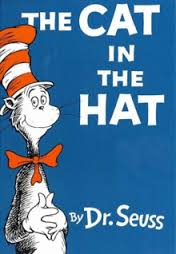
• Strong cause-and-effect. I can still remember that, as a small child reading THE CAT IN THE HAT by Dr Seuss, I actually held my breath when turning one particular page. On that page, the cat was balanced on a ball, holding aloft a huge, teetering tower of things. Could he possibly stay upright? I cringed and turned the page... Nope!


• An escalating problem. THERE WAS AN OLD DRAGON WHO SWALLOWED A KNIGHT by Penny Parker Klostermann and Ben Mantle is a prime example of escalation. The dragon keeps swallowing things, and his growing stomach discomfort surely cannot end well.


In addition to a strong story, or in quieter books or concept books, some other techniques can encourage page turns:

• The use of questions. The nonfiction book, WHAT DO YOU DO WITH A TAIL LIKE THIS? (by Steve Jenkins and Robin Page) uses this technique. To find the answers to this question -

   - readers must turn the page.


• Rhyme. With rhyme, a missing end rhyme will encourage the reader to guess the last word of the stanza, and then turn the page to confirm their guess. Take a look at Miranda Paul's new book, WHOSE HANDS ARE THESE?, illustrated by Luciana Powell. 
(*A warning here -- only write in rhyme if your story demands it and you work diligently to make all the elements of rhyme work. Here is a post on that topic.)


• Sparse text. The best example I can think of for this technique is YO! YES? by Chris Raschka. The entire book contains fewer words than most of my sentences! With few words, readers move forward quickly to add to the story. This book also uses the next technique -


• Alternating characters. With two characters that are fairly balanced in importance and appearance in the story, readers will keep turning the pages to see what is going on with the other character. HERMAN AND ROSIE by Gus Gordon is a personal favorite of mine.


• The use of a "page-turning word" and/or an ellipsis. Alice Schertle uses both in ALL YOU NEED FOR A SNOWMAN, illustrated by Barbara Lavallee. On the spread below, the word "then" followed by an ellipsis requires a page turn to complete the sentence and move things forward.


Picture book editors read tons of picture books and submissions of yet-to-be picture books, so many that they develop a feel, an internal rhythm, of where a page turn occurs. As they read your text, they will subconsciously break your picture book into spreads, adding page turns in their mind. 

You can develop that same feel, that internal rhythm. You can also encourage page turns. How?

#1 READ LOTS OF PICTURE BOOKS

#2 MAKE A DUMMY OF 
YOUR PICTURE BOOK TEXT

#3 INCORPORATE ELEMENTS 
TO ENCOURAGE PAGE TURNS

Never made a dummy before? Don't worry - there's a post for that, too! Check it out here.


So what is your favorite page-turner picture book, GROG readers? Does it include any of the elements above? Something else?

Wednesday, December 16, 2015

WHOSE HANDS ARE THESE? by Miranda Paul, Review by Kathy Halsey

Young children like to be engaged in a book, and Miranda Paul gives readers (age range 3-7) plenty of opportunities to be "hands-on" with her newest rhyming nonfiction picture book WHOSE HANDS ARE THESE? A COMMUNITY HELPER GUESSING BOOK from Millbrook Press, publication date Feb. 1, 2016.
A hybrid book, traditional picture book and guessing game, WHOSE HANDS features jobs traditionally explored with this age group, and occupations not as commonly known for the younger set. Readers learn about potters, news reporters, architects, and referees along with farmers, police, teachers and scientists. The bright, and inclusive illustrations by Brazilian native Luciana Navarro Powell, ensure that minorities are well-represented, too. People of color, women, and older people are included in the array of helpful careers. 
Structure & Design
Miranda and Luciana have found a great format for this guessing game using the page turn as a strong artistic device. For each occupation, we first see the hands at work coupled with the bouncy rhythm and rhyme. Next, the full page reveal completes the rhyme and we see/learn the answer to our question. For example, the science spread begins:
"Quest and test, these hands are turning,
Test again - these hands are learning!
Weight and count, their work persists.
These hands belong to...(page turn)

Scientists!"

This repeating structure helps younger children predict and even anticipate the ellipsis and the page turn reveal. Even the first page takes advantage of the unique quality of the page turn as we see a hand ready to turn the page accompanying the text "Can you guess? Whose hands are these?"

Another design element that distinguish this book includes the deliberate order of occupations. The book begins with farmers and moves seamlessly to cooks - a la "farm to table." Children and astute adults can discuss where food begins and ends. The occupations conclude with the teacher who introduces Career Day in the next spread and there, on the bulletin board, the reader finds the final question, "What could your hands do?" 

The end papers delineate all the implements/tools of the trade for each occupation and another opportunity to engage children in guessing who uses what tool. Then the back matter gives us a visual cameo of all eleven occupations pulled from the book with detailed occupational information and handy synonyms for the career. Finally, the author's note inspires children and adults to dream big and fulfill their dreams. 

Author Miranda Paul and illustrator Luciana Navarro Powell give caregivers, teachers, librarians, parents, children and writers many reasons to read WHOSE HANDS ARE THESE over and over again for entertainment and information.