Wednesday, April 20, 2016

Virginia Hamilton Multicultural Conference: Diversity in Poetry, Prose, and Pictures by Kathy Halsey


The Virginia Hamilton Conference on Multicultural Literature for Youth, 32 years young, is the longest running multicultural children's conference in the country. This year Nikki Grimes, Margarita Engle, Christian Robinson, Angela Johnson and Helen Frost assembled to share their award-winning books and thoughts on the campus of Kent State University.
Nikki Grimes shares her dreams
On a snowy April eve, keynote speaker Nikki Grimes warmed our hearts and shared her thoughts on the wonderful novel in verse, WORDS WITH WINGS. 
Words that winged their way into my notebook:

  • "I write books about children who look and feel like me."
  • When writing, remember that "...the best worlds are formed from the architecture of dreams."
  • Set aside time to play when beginning a new work.
  • Good stories share "compassion, sympathy, and empathy."
  • What can writers do to confront the world's atrocities? Begin with empathy. "The most important common denominator is heart, and we can start with books." 
  • WORDS WITH WINGS is a story "about the beauty of a little girl's interior life that is not valued."
  • Daydreams are important for writers AND children. Do not discourage, but encourage daydreaming in students. It is the seed of creativity and invention.
Robinson draws a Corgi at my suggestion.
Christian Robinson, Caldecott illustrator for LAST STOP ON MARKET STREET treated us to spontaneous sketches and his influences during his presentation: 

  • Drawing gave him a way to express himself in a world he wanted to see.
  • Influences include Leo Lionni, Ezra Jack Keats, Roger Duvoisin; animators Mary Blair, Walter Peregoy, and Eyvind Earle.
  • As a Pixar intern, he worked on the movie Up, but was then let go.  
  • He gave himself illustration projects to keep himself working and posted them on his blog. Eventually, agent Steven Malk found his work while scrolling the net one day.
  • Riding the bus with his Nana, who raised him, inspired the art for MARKET STREET. 
  • Take heart, writers and illustrators. Christian told us he is "overwhelmed and scared every time he starts a book."
    Margarita Engle
The poetic contributions from the "honored guest" authors continued with Margarita Engle, who shared such goodness with us:

  •  Her books are about power. "Characters are powerful and so are words."
  • Margarita wrote ENCHANTED AIR: TWO CULTURES, TWO WINGS: A MEMOIR for "peace and reconciliation."
  • She feels that "rhyme and musical language can soften the blow of difficult topics."
  • Why write in free verse? "Poetry makes me happy," Margarita says. 
    A stellar line-up of honored guests and authors Christian Robinson, Nikki Grimes, Helen Frost and Margarita Engle

    In two days, attendees were treated to sixteen breakout sessions that focused on diversity and culture, wonderful dinners and repasts, a reception with the authors, and book giveaways. This is a conference you want to pencil into your calendar for next year, April 6 and 7, 2017. A big thank you to the conference committee and Arnold and Jaime Adoff for carrying on Virginia Hamilton's legacy. As Arnold says, "The struggle continues."


Monday, April 18, 2016

Turn that Picture Book Page! ~ by Patricia Toht

Webster's Dictionary defines a page-turner as "a book, story, etc., that is difficult to stop reading because it is so interesting." 

So, what makes for a great page turn in a picture book? What compels readers to flip to the next spread? 

Above all, a strong story will do the trick, a story that contains elements that propel action forward. Some involve:


• A trip, like this year's Newbery winner, LAST STOP ON MARKET STREET by Matt de la Peña and Christian Robinson. Readers want to know where the journey will ultimately end up.


• A quest, like SAM AND DAVE DIG A HOLE by Mac Barnett and Jon Klassen. Readers turn the page to discover if these diggers will find something spectacular, after all.


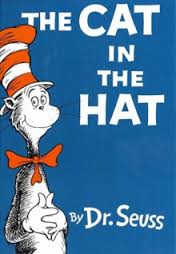
• Strong cause-and-effect. I can still remember that, as a small child reading THE CAT IN THE HAT by Dr Seuss, I actually held my breath when turning one particular page. On that page, the cat was balanced on a ball, holding aloft a huge, teetering tower of things. Could he possibly stay upright? I cringed and turned the page... Nope!


• An escalating problem. THERE WAS AN OLD DRAGON WHO SWALLOWED A KNIGHT by Penny Parker Klostermann and Ben Mantle is a prime example of escalation. The dragon keeps swallowing things, and his growing stomach discomfort surely cannot end well.


In addition to a strong story, or in quieter books or concept books, some other techniques can encourage page turns:

• The use of questions. The nonfiction book, WHAT DO YOU DO WITH A TAIL LIKE THIS? (by Steve Jenkins and Robin Page) uses this technique. To find the answers to this question -

   - readers must turn the page.


• Rhyme. With rhyme, a missing end rhyme will encourage the reader to guess the last word of the stanza, and then turn the page to confirm their guess. Take a look at Miranda Paul's new book, WHOSE HANDS ARE THESE?, illustrated by Luciana Powell. 
(*A warning here -- only write in rhyme if your story demands it and you work diligently to make all the elements of rhyme work. Here is a post on that topic.)


• Sparse text. The best example I can think of for this technique is YO! YES? by Chris Raschka. The entire book contains fewer words than most of my sentences! With few words, readers move forward quickly to add to the story. This book also uses the next technique -


• Alternating characters. With two characters that are fairly balanced in importance and appearance in the story, readers will keep turning the pages to see what is going on with the other character. HERMAN AND ROSIE by Gus Gordon is a personal favorite of mine.


• The use of a "page-turning word" and/or an ellipsis. Alice Schertle uses both in ALL YOU NEED FOR A SNOWMAN, illustrated by Barbara Lavallee. On the spread below, the word "then" followed by an ellipsis requires a page turn to complete the sentence and move things forward.


Picture book editors read tons of picture books and submissions of yet-to-be picture books, so many that they develop a feel, an internal rhythm, of where a page turn occurs. As they read your text, they will subconsciously break your picture book into spreads, adding page turns in their mind. 

You can develop that same feel, that internal rhythm. You can also encourage page turns. How?

#1 READ LOTS OF PICTURE BOOKS

#2 MAKE A DUMMY OF 
YOUR PICTURE BOOK TEXT

#3 INCORPORATE ELEMENTS 
TO ENCOURAGE PAGE TURNS

Never made a dummy before? Don't worry - there's a post for that, too! Check it out here.


So what is your favorite page-turner picture book, GROG readers? Does it include any of the elements above? Something else?

Friday, April 15, 2016

More Poetry Month Love


More Poetry Month Love
by J.G. Annino


If you manage to entice your Muses to visit you,
might you write poetry?

Conversely-
could someone else’s poetry be the Muse for you?

Reading poetry that connects, that zings, opens your heart,
can entice in, the Muse that spurs you to write -  and, not
necessarily to write poetry. But to write whatever it is
that is on your heart.

As Christy shared so creatively on our Aprl 11, 2016
Group Blog, this is National Poetry Month!
My hope with this visit, is to incubate the idea that
picking up a classic poetry collection that you
dip in and out of without pressure, could lead to
an ephinany, an “ah, ha” moment in your own writing.


Robert Pinsky
Favorite Poem Project Poet, Robert Pinsky
Such an honor!  The former U.S. poet laureate,
Robert Pinsky, brought the national Favorite Poem Reading
Project to our town, Tallahassee, recently.


Of course we managed to get to the event. 
Everyday people from around the state of Florida read a poem,
by an established author. This is the road show for a previous online
invitation at the Favorite Poem website. I didn't enter, as it was some
time back. But I'm so glad so many people did.

They picked one poem that over and over, calls to them.
This is one of Robert Pinsky’s favorite challenges. To ask everyone to
find a favorite poem or two, read them regularly,  and further, he urges
us to read the poem out loud and not stop there. Memorize a favorite poem.
That allows you to carry it with you, everywhere.

 This acclaimed poet looks like a cross between Bill Nye, the
Science Guy & that great space educator Carl Sagan. He was
just as engaging as each of them.  “A poem is a work of art made
for a human voice,” he told us. “But it’s not the art of one expert.
It’s the art of any and all.”

Here are just three of the poems read that evening.

“Nick and the Candlestick,” Sylvia Plath
“Why I Am Not A Painter,” Frank O’Hara
“Soneto XVII” Pablo Neruda
  

And I still remember how Pinsky quoted James Baldwin,
“Culture is everybody’s birthright.”

So, everybody, I have always been one of those who can't pick one
favorite poem. But he said in that case, know that you are
working with one of your favorites. Despite the title of the project,
it doesn't have to be THE one and true only favorite. Like picking 
among children, impossible to do.

So here is the title of a poem section I like a whole lot among
many favorites. It is, "Alphabets," (part 1) and it is 
from the pen of the great Seamus Heaney. It begins, 

Alphabets
by Seamus Heaney

"A shadow his father makes with joined hands
And thumbs and fingers nibbles on the wall
Like a rabbit's head. He understands
He will understand more when he goes to school.

There he draws smoke with chalk the whole first week.
Then he draws the forked stick that they call a Y.
This is writing. A swan's neck and swan's back
Make the 2 he can see now as well as say..."
c. Seamus Heaney


Wednesday, April 13, 2016

National Library Week

Designed by Gene Luen Yang,
an award-winning graphic novelist.
It's National Library Week, April 10 - 16, 2016.

The American Library Association [ALA] sponsored the first National Library Week, in 1958, to share a public awareness for libraries and an appreciation for librarians. The ALA continues to promote the use and support of libraries and library contributions across our nation every April.

Visit your local library and show your support to celebrate libraries. For more information about additional ideas check out I Love Libraries here.

The library is an important institution that offers many opportunities for families to learn and grow together. From wee little ones to *silver people* and every age in between, a library has something for everyone. All you need is a library card. 
Stack of books
National Library Week is a time to recognize the valuable contributions that libraries make for communities throughout the nation. From public libraries to school libraries, bookmobiles, and the Little Free Libraries throughout your neighborhood.

Participate in ALA's #LibrariesTransform public awareness promotion. Create your own Because Statement and fill in the blank by telling your story of why your library is important.

For more ALA celebrations throughout the month of April and throughout the remainder of the year check out this link about promotions and events. 

Remember eight year old RAMONA QUIMBY?
Happy Birthday
Beverly Cleary!
 
This week [and during the entire month of April] in honor of author Beverly Cleary's 100th birthday, let's make reading a priority. Let's Drop Everything and Read, D. E. A. R. with Ramona Quimby and a tall stack of books. 

That's what I am doing.

Mrs. Sue reads
during Literacy Night
at St. Michael's School

That's what my seven sweet and sometimes sassy grands are doing.
Oma Sue loves Johannah, Joshua & Jaxon.
Oma Sue loves Lily & Lane.
 
Oma Sue loves Charlotte.
Oma Sue loves Henry.
Remember to thank a librarian and the many dedicated professionals who work hard to make our libraries special. 

High five for fellow GROG authors and librarians: Todd Burleson, Marcie Flinchum Atkins, Kathy Halsey and Pat Miller. Thank you for the many hours spent in a library, motivating and sharing literacy with library patrons, story time readings, supporting children with independent research, selecting and classifying library sources, making book recommendations to teachers and students, and checking out, shelving many, many titles and much more.

Celebrate the love of literacy. Celebrate libraries.


Monday, April 11, 2016

A Poem for Writers -- by Christy Mihaly

For Poetry month, here at GROG we've reached back into the vaults. 

Where did that muse go?
Today's poem is dedicated to all those writers who worry, from time to time, that their muse has gone missing; and all those writers who keep on writing despite the distractions at hand.

Enjoy! And keep the faith.


MUSE 


Inspiration, where’s thy flow?
My Muse, elusive, just won’t show.

Butt in chair, and hands on keys,
My mind floats off upon the breeze.

Clearly I’m no good at this,
My composition’s hit-or-miss.

As the minutes tick on by
My story line begins to die.

Why keep up this “writer” pose?
My verses simply decompose!

Then, I hear a small voice call:
My baby’s crying, down the hall.

Right on cue, a brainstorm comes,
My babe wakes up, and my head hums!

Hurry, quick! I’ve no more time –
My words begin to rush, and rhyme!

“Coming, Sweetie Pie,” I shout;
My fingers fly, thoughts tumble out.
No, Cheddar. That's BUTT in chair.

Naptime’s done! I shake my head,
My little Muse is out of bed.

-- by Christy Mihaly

©2014 Christy Mihaly 
all rights to poem reserved


Friday, April 8, 2016

What Good Writers Do ~By Suzy Leopold

Showing up where you are with what you have is what good writers do.

Are you showing up where you are with what you have? 

In January, many writers set goals and resolutions when the 2016 calendar began. Perhaps it is time to revisit your set of writer’s goals.

Think about and check your list of short-term goals and your long-term SMART goals. Has your plan provided you with the results that you set out to achieve?

First Step: Set Goals
Second Step: Get to Work
Third Step: Stick to It
Fourth Step: Make a Plan
Fifth Step: Achieve
If your established plan is working, celebrate your accomplishments both big and small. Perhaps there are some areas where you can improve. Adjust as need be. For more information see a previous post Ready or Not. It's Time to Show Up.

As I look back on the first three months of 2016, I note there are some days when I stumble with the Third Step: Stick to It. Sometimes just sticking to my plan and sitting down to begin writing is all it takes. 

It’s easier to make unacceptable excuses for not writing today:

It must be writer’s block.
I’m waiting for inspiration to strike.
I don’t want to stare at this blank page.

No excuses allowed. Stop the stagnation. Dismiss negative thoughts that zap your productivity. Surround yourself with positive thoughts and find determination. Sure, there will be some days when you skip and stumble a step or two when  writing does not happen. It's okay. Take small steps and move forward without being critical of yourself. Think about what works best for you and your writing career.

There are many days when I feel I can justify my unacceptable excuses for not sticking to it. Yet, I know I need to believe in my voice and learn to ward off the urge to procrastinate. 

Making time to write is both a matter of desire as it is discipline. It takes determination. 

Writing can be compared to exercise. You feel better once you’ve done it.  
Created by my
Cousin Sheri McCulley Seibold
If inspiration is eluding you consider crafting a new story. Select an idea you wrote down during Tara Lazar's PiBoIdMo Writing Challenge. Feel accomplished after revising a manuscript. Refer to a stack of books as mentor texts from the research that you did during ReFoReMo, with Carrie Charley Brown. Participate in Angie Karcher's RhyPiBoMo that she hosts this month. Writers will grow and learn from the many resources, lessons and writing prompts. 

Write a blog post about a recently read book about the craft of writing that you found inspiring. Set a timer and chase after your daily word count. Consider establishing some agreed upon rules, expectations and most importantly accountability with a critique partner or group. By checking in with a writerly friend, I feel I can do a better job of holding myself accountable to my promises and aspirations than just checking in with myself. Perhaps heading to your local indie book store or the public library you will find some ideas and inspiration, along with time to read and write.
Time to revise & edit.
A stack of mentor texts.
One more thought. Take your writing serious. Make sure you go to work because this is your job. Your boss does not accept excuses for lack of inspiration, for feeling tired, for not showing up nor other lame excuses that you can think of. And don't forget the importance of having a set of business cards. This is your career.
Business cards
So grab your writer’s tools: a computer, a journal, a pen or a pencil, a highlighter, a dictionary, a thesaurus, a stack of mentor texts, a cup of hot tea and turn on some music to find your muse. You can do it! Yes, you can!
Would you like some sugar or
a slice of lemon with your tea?
One thousand crumby words on paper are better than one hundred thousand fabulous words that are in your head.

Make writing a habit and you’ll see improvement in you writing.

A writer writes. Write, always.